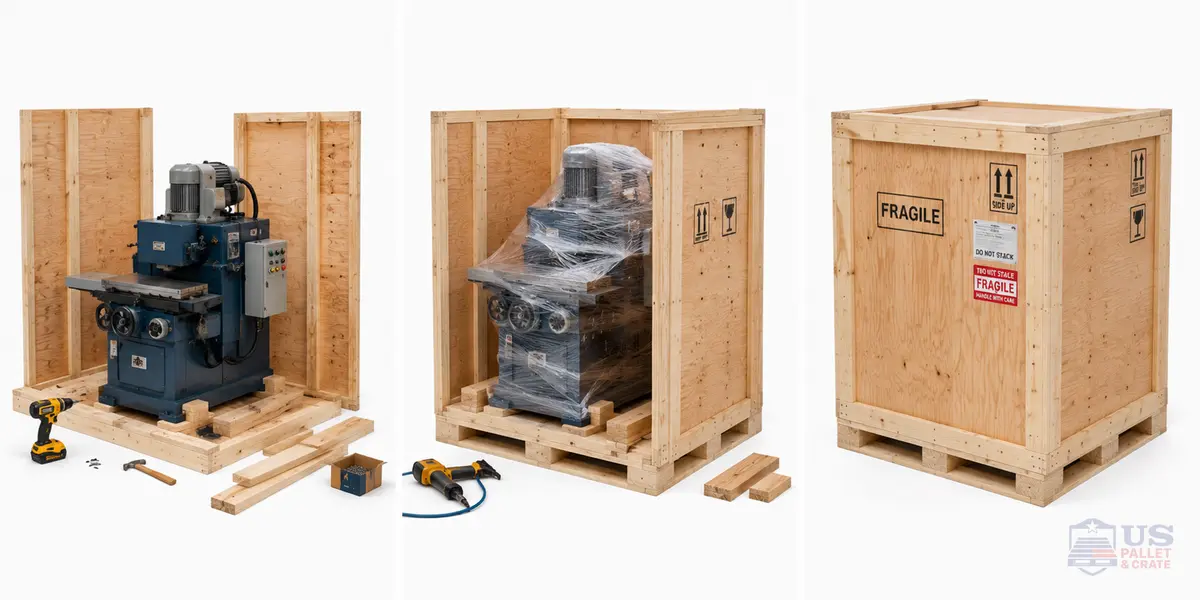
You need six things: the outside dimensions of what you are shipping, its weight, where that weight sits inside the crate, how the crate gets handled, how it travels, and whether it leaves the country. Give a crate shop those six and you get real pricing, usually the same day. Leave one out and you get a guess, which is how loads end up in crates that are too weak, too heavy, or twice the price they needed to be.
Every quote comes down to the same short list. You do not need drawings and you do not need engineering. You need these.
| What we need | Why it changes the build |
|---|---|
| Length, width and height of the item at its widest points | Sets the inside dimensions. We add clearance for cushioning and bracing on top of your numbers. |
| Total weight | Sets lumber thickness, skid size and fastener pattern. |
| Where the weight sits | A motor with all its mass at one end needs bracing an evenly loaded crate does not. |
| How it gets picked up | Forklift, pallet jack, crane or a combination. This decides skid height, fork openings and whether you need lifting points. |
| How it travels and whether it stacks | Truck, ocean container and air freight punish a crate differently. Anything stacked on top has to be carried by the crate, not by your product. |
| Whether it crosses a border | International shipments pull in wood treatment rules. See the ISPM-15 section below. |
A photo helps more than people expect. One picture of the item on the floor tells us about shape, fragile protrusions and lifting points faster than a paragraph does.
Measure the widest point in each direction, not the body of the machine. Handles, brackets, shafts, gauges and control boxes all count. If a fitting sticks out three inches, the crate has to clear three inches.
Then decide what comes off. Removing a protruding handle or a control arm and packing it separately inside the same crate often drops a full size class off the build. Smaller crate, less lumber, lower freight cost. It is the cheapest saving available on most custom jobs.
Measure the item, then add clearance for cushioning on every face. Do not send us the crate size you think you want. Send us the item size and let the build math run from there.
Two crates can weigh the same and need completely different builds. A pallet of evenly stacked boxes spreads its load across the whole deck. A single machine with its motor on one corner puts most of the weight into a small area, and that is where the floor of the crate fails first.
Tell us roughly where the mass sits and whether the item is top heavy. Top heavy loads tip during handling, which means the crate needs to resist forces sideways as well as down. That changes the bracing, not just the lumber.
| Style | Best for | Trade off |
|---|---|---|
| Closed sheathed crate | Anything that needs protection from weather, dust or prying eyes | Heaviest and most material |
| Open slat or skeleton crate | Heavy, rugged items where you want to see the contents and cut weight | No protection from dust or moisture |
| Wirebound crate | Lighter goods, high volume, ships flat and assembles fast | Not built for heavy machinery |
| Heavy duty export crate | Ocean freight, rough handling, long transit | Costs more up front and weighs more |
| Metal crate | Very heavy, high value or security sensitive freight | Highest cost, needs different handling |
Most people default to a closed crate because it feels safest. For a rugged steel fabrication going 200 miles on a flatbed, an open slat build protects it just as well, weighs less and costs less. We will tell you when you are buying protection you do not need. That is part of the quote.
If it does, the wood has to be debarked, treated by an approved method and stamped. This is the ISPM-15 standard and it applies to the crate, the skid and any loose dunnage inside it. Wood that is not treated and marked correctly gives the receiving country the right to hold, treat, destroy or return your shipment.
Say so at quote time, not after the crate is built. Retrofitting compliance onto a finished crate is slower and more expensive than building it right the first time. We cover the detail in our guide to what ISPM-15 actually requires, and we build to it through Heavy Duty & Export Crate Supply.
A customer asks for a 60 by 40 by 48 crate because that is what they used last time. The item changed. Now there is nine inches of empty space inside, which becomes movement in transit, which becomes damage. Give us the item. We will give you the crate.
A crate that a forklift cannot get under is a crate that gets dragged, dropped or unloaded by hand. Skid height and fork opening are cheap to get right at build time and expensive to fix at the dock.
Fear drives a lot of packaging spend. Doubling the lumber on a crate that never needed it adds material cost, adds weight, and adds freight cost on every single shipment for the life of that spec. Over specification is a recurring charge.
The other direction is worse. One damaged machine usually costs more than the entire crate order it came from, before you count the delay, the replacement and the customer conversation.
If crates get stacked two or three high in a warehouse or a container, the bottom crate carries all of it. Tell us the stack height. It changes the top deck and the corner posts.
An email with these five lines is enough to get a same day quote in most cases:
A photo on top of that gets you a sharper number. Send it to sales@uspalletandcrate.com or start a quote below.
For reference: our maximum single crate size is 6 ft x 6 ft x 6 ft, standard lead time is 3 to 7 days, and the minimum order quantity is 10.
We build all of this under Custom Crate Supply, in wood, metal or a hybrid of the two.
Contact our office for further assistance. We are here to provide clear answers and help you understand how we can meet your needs effectively.
Call Us (832) 702-8480No. Dimensions, weight and a description of what you are shipping is enough for us to quote. Drawings help on complex builds but they are not required.
Enough for cushioning and bracing on every face. The exact allowance depends on weight, fragility and how the crate travels, so we work it out from your item dimensions rather than asking you to guess.
In wood packaging a crate carries its strength in the frame, and the sheathing is a skin. A box carries its strength in the panels themselves. Crates handle heavier and more concentrated loads.
Yes, and it is usually cheaper. If you ship the same item regularly we build a repeatable spec, which speeds production and brings the per unit cost down on later runs.
No. We build wood, steel and hybrid wood and metal crates. Wood suits most freight. Metal makes sense for very heavy, very high value or security sensitive loads.
Yes. We build both one time crates and recurring production runs. Larger volumes get better per unit pricing but there is no requirement to commit to a run.
We fix it. If an order is not right we make it right at no cost to you.
Often yes. Detaching a handle, arm or bracket and packing it inside the same crate can drop the crate a whole size class, which lowers both the crate cost and the freight cost on every shipment.
