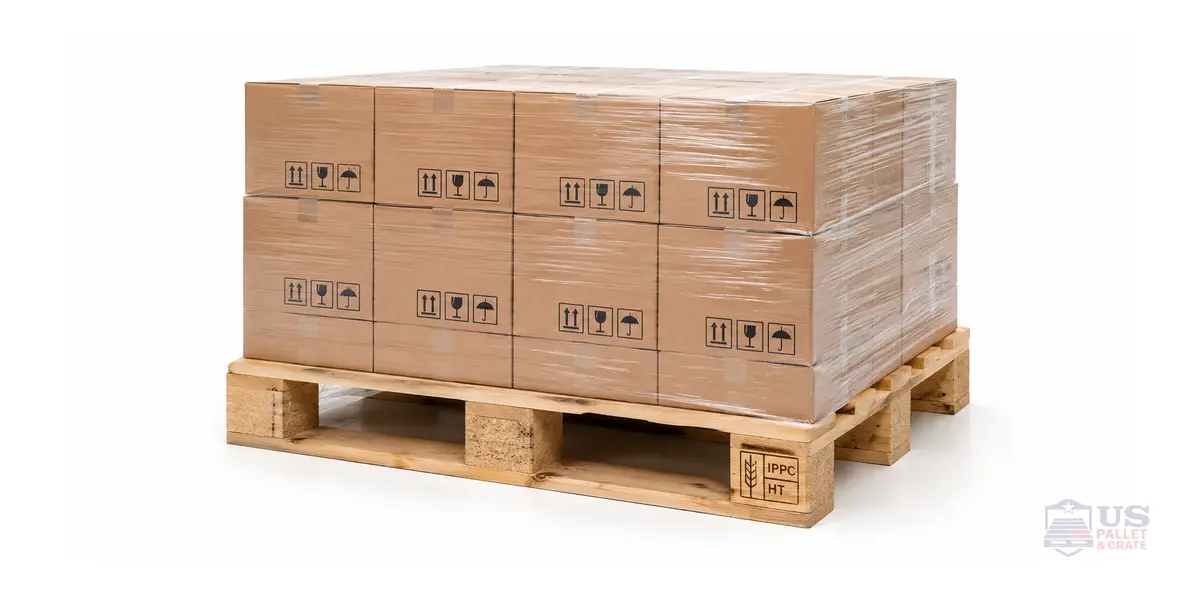
ISPM-15 is the international standard for wood packaging that crosses a border. Solid wood pallets, crates, boxes, skids, dunnage, cable drums and spools all fall under it. The wood has to be debarked, treated by an approved method, and stamped with a registered mark. Plywood, OSB, particleboard, veneer and wood 6 mm or thinner are exempt because the manufacturing already removes the pest risk. Get the mark wrong and the receiving country can detain, treat, destroy or return the shipment.
The standard covers wood packaging made from raw wood: crates, boxes, packing cases, dunnage, pallets, cable drums and spools. The exemptions are specific and worth knowing, because people pay for treatment they do not need.
Exempt under ISPM-15:
Two caveats. The barrel and gift box exemptions are conditional, not automatic, because not every one is built in a way that renders it pest free. And note that US regulation defines regulated material as wood less than 6 mm thick, while ISPM-15 itself says 6 mm or less. At exactly 6 mm those two do not say the same thing, so if you are sitting on that line, treat it.
Whatever treatment you use, the wood has to be debarked. Small amounts of bark are tolerated: pieces less than 3 cm wide regardless of length, or wider pieces where the individual piece has a surface area under 50 square cm. For chemical treatments the debarking has to happen first. For heat treatment it can happen before or after.
Four treatments are approved under the current standard. In practice, wood coming out of a US facility carries HT or MB, because those are the two programs the American Lumber Standard Committee runs.
| Code | Treatment | Requirement |
|---|---|---|
| HT | Heat treatment | Minimum 56°C for a minimum of 30 continuous minutes throughout the entire profile of the wood, including the core |
| DH | Dielectric heating | Minimum 60°C for 1 continuous minute throughout the profile including the surface. Above 5 cm thickness it needs bidirectional application or multiple waveguides |
| MB | Methyl bromide fumigation | Still permitted. Not allowed on wood over 20 cm at its smallest cross section. Minimum 24 hour exposure, wood and air not below 10°C |
| SF | Sulphuryl fluoride | Added to the standard in 2018. Same 20 cm cross section limit. There is no US program for it, so you will not obtain an SF mark here |
Methyl bromide depletes the ozone layer, and the IPPC has an adopted recommendation encouraging countries to replace or reduce it. The EU has banned carrying out methyl bromide fumigation for quarantine and pre shipment use since 2010. That is a rule about performing the treatment inside the EU, which is a different question from whether the EU accepts imported wood already bearing an MB mark, and those two get confused constantly.
Older guidance told you to add "DB" to the stamp when debarking was required. That came out of the 2002 and 2006 versions of the standard. Debarking has been mandatory for all wood packaging since the 2009 revision, so the separate marker became redundant and it does not appear in the current standard at all. Do not add it.
No, and this one catches people every year.
Kiln drying is a process for reducing moisture. It is not a guarantee that the wood reached the temperature and duration needed to kill pests. Heat treatment as a phytosanitary measure does not care about moisture at all. It is defined purely as a minimum wood temperature held for a minimum time.
A kiln can be used to deliver heat treatment, but only if it hits the 56°C core temperature for 30 continuous minutes and the facility is running an approved schedule. In the US program, KD is a moisture designation stacked on top of HT. You will see a stamp reading "HT" or "KD HT". You will never see "KD" alone as a valid ISPM-15 treatment code. If a supplier tells you their pallets are kiln dried so they are fine for export, that is not an answer.
Four elements, inside a bordered rectangle or square with a vertical line separating the symbol from the codes:
The mark has to be legible without a magnifying glass, durable, not transferable, and never hand drawn. It should appear on at least two opposite sides of the unit so an inspector can find it. Red and orange should be avoided because those colors are used for dangerous goods labeling. Nothing else goes inside the border. Producer trademarks and agency logos sit outside it.
The country code has to be separated from the producer code by a hyphen. That hyphen matters more than it looks, because it is one of the details inspectors use to spot fraudulent marks.
So many shipments were failing on the hyphen alone that APHIS suspended enforcement of it through 31 December 2025. That suspension is over. APHIS and CBP resumed enforcement on 1 January 2026. If you are holding stock marked "US 000 HT" instead of "US-000" with the treatment code on its own line or after a hyphen, that stock is exposed now.
Not you, and not your pallet supplier unless they are registered.
In the United States, APHIS is the national plant protection organization, and it delegates the wood packaging program to the American Lumber Standard Committee. ALSC accredits third party inspection agencies, and those agencies license individual facilities. APHIS puts it plainly: you cannot make your own ISPM-15 mark, you have to be registered with an accredited inspection agency. ALSC currently reports 15 accredited agencies covering roughly 5,300 facilities.
There are three legitimate ways to end up with compliant wood packaging. Buy it already marked. Manufacture it from ALSC accredited heat treated grade marked lumber. Or treat and mark it yourself at a registered facility.
One more thing worth knowing: APHIS will not issue a phytosanitary certificate for wood packaging used to transport goods. If somebody offers you one for your pallets, something is wrong. A certificate is only issued when the wood packaging itself is the cargo.
Ask us for the accredited agency and facility number behind our own stamp and we will send it to you in writing, the same way we are telling you to ask every other supplier.
The standard allows the receiving country to detain the consignment, then remove the offending material, treat it, destroy it or send it back. The principle is meant to be minimal impact, separating the goods from the packaging where possible, but that is a principle, not a promise.
Inbound to the US the process is concrete. An Emergency Action Notification is issued, and the options are safeguarding the shipment, destroying the non compliant wood under supervision, or re exporting it. An inspector at the port of first arrival can order immediate re export of wood packaging that arrives without the mark. Then comes a traceback investigation of the exporter, the supplier and the production site.
Under CBP's mitigation guidelines the penalty is computed on the value of the articles introduced, and that expressly includes the cargo as well as the wood packaging. A pallet worth a few dollars can put an entire container's value in scope. Mitigation runs 1 to 10 percent of the assessed penalty on a first violation, 10 to 25 percent on a second, and not lower than 25 percent after that. Failing to comply with the notice itself carries liquidated damages cancelled between $500 and $5,000.
What inspectors flag on sight: inappropriate marks, illegible marks, no border, the wrong logo, the mark stamped on the wrong component, no mark at all, visible pest damage such as exit holes or frass, and a mix of new and old wood in the same unit.
Mexico does. It appears on the APHIS list of countries requiring ISPM-15 with no exemption. Crates going to Monterrey need a compliant mark like anywhere else.
Canada is the exception, and it is narrower than people think. The US and Canada have a mutual exemption for wood packaging made from wood originating in the continental United States or Canada. It is a documentation based exemption, not an automatic one. To get it, the import paperwork has to carry one of these statements: "The wood packaging material originated in the Continental US" or "The wood packaging material originated in Canada". Without that line on the documents, unmarked wood is non compliant. Hawaii and US territories are outside the exemption and need the mark.
Going the other way, treatment and a mark are not required when shipping to Hawaii, Puerto Rico or the US trust territories from the mainland United States, but they are required when shipping there from other countries.
Reuse is fine. A treated and marked unit that has not been repaired, remanufactured or altered does not need re treatment or a new mark for the rest of its service life. The treatment does not expire.
Repair and remanufacture are where it gets strict.
This is the most common failure and the easiest to fix. All dunnage used to secure or support a load has to be treated and marked, same as the pallet. Small offcuts that do not carry every element of the mark should not be used as dunnage at all. If your dock is bracing loads with whatever timber is lying around, that is a compliance problem waiting for a port inspector.
Inspectors are trained to look for a mix of new and old wood. A repaired pallet with one untreated replacement board is a non compliant pallet.
The exporter carries the consequence, not the pallet yard. Verify the agency and facility number once, in writing, and keep it on file.
Treatment providers are required to keep treatment and calibration records for a period set by the national authority. In the US, facilities also have to hold records showing where their heat treated lumber came from and that purchase volumes are consistent with the quantity they are stamping. That volume reconciliation is what catches over stamping.
If you export out of Houston, three checks are worth doing this week. Look at a pallet in your yard and confirm there is a hyphen after the country code. Confirm your dunnage is marked. Confirm you know which accredited agency stands behind your supplier's stamp.
When you need the wood itself, we supply Heat-Treated Pallet Supply (ISPM-15) for export pallets and Heavy Duty & Export Crate Supply for ocean freight crating. If you are still working out the crate build, start with how to spec a custom crate.
This guide explains the rules. It is not legal or regulatory advice, and the receiving country always has the final say on your shipment.
Contact our office for further assistance. We are here to provide clear answers and help you understand how we can meet your needs effectively.
Call Us (832) 702-8480A minimum of 56 degrees Celsius for a minimum of 30 continuous minutes throughout the entire profile of the wood, including the core.
No. Kiln drying reduces moisture and does not by itself prove the wood reached the required temperature for the required time. A kiln can deliver heat treatment, but only under an approved schedule at a registered facility. In the US you will see HT or KD HT on the stamp, never KD alone.
Yes. Packaging made wholly of processed wood such as plywood, particle board, oriented strand board or veneer is exempt, because it is made using glue, heat or pressure. Wood 6 mm or less in thickness is also exempt.
The ISPM-15 mark has to separate the two letter country code from the producer code with a hyphen. APHIS suspended enforcement of that detail through 31 December 2025 and resumed enforcement on 1 January 2026. A missing hyphen is a common sign of a fraudulent mark, which is why it is checked.
No. In the United States you must be registered with an inspection agency accredited by the American Lumber Standard Committee. Applying an unregistered mark is fraud, not a shortcut.
Not if the wood originated in the continental United States or Canada, but the exemption depends on paperwork. The import documentation must carry a statement that the wood packaging material originated in the Continental US or in Canada. Without that statement the shipment is non compliant. Mexico has no exemption.
No. A treated and marked pallet that has not been repaired, remanufactured or altered keeps its status for the rest of its service life. The treatment does not expire.
The receiving country can detain it and then require removal, treatment, destruction or re export. In the US an Emergency Action Notification is issued and a traceback investigation follows. Penalties are calculated on the value of the goods as well as the wood packaging.
Yes. All dunnage used to secure or support a load must be treated and marked. Small offcuts that do not carry the complete mark should not be used as dunnage.
