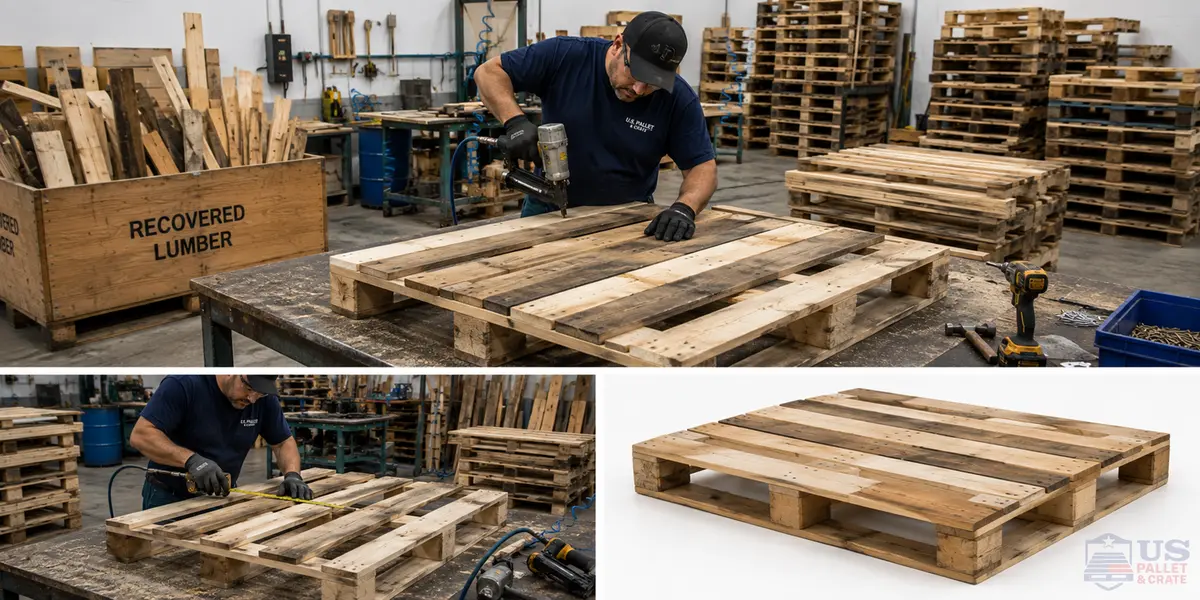
Buy new when the pallet has to be clean, dimensionally consistent, or leaving the country. Buy recycled when it moves inside a loop you control and you accept some variation. Buy remanufactured when you want close to recycled pricing at a size or strength the recycled market does not stock. Most operations need more than one of these. The expensive mistake is picking one grade and using it for everything you ship.
| What it is | Best for | |
|---|---|---|
| New | Built from fresh lumber to one spec. Every unit the same size, same wood, same nail pattern, no previous life. | Export, food and pharma, cleanrooms, automated handling, anything customer facing, any load where consistency matters |
| Recycled | A used pallet recovered, inspected and repaired as needed, then sorted to a grade. Usually a standard size, most often 48 x 40. | Closed loops, internal movement, warehouse staging, general freight where appearance and exact consistency do not drive anything |
| Remanufactured | Dismantled pallets rebuilt from sound recovered components, often into a size or configuration the used market does not carry. Combo pallets mix recovered and new lumber. | Non standard sizes on a budget, heavier duty than a standard recycled unit, high volume where new is more pallet than the job needs |
The short version: new buys you consistency, recycled buys you price, and remanufactured buys you a size or strength you cannot get cheaply any other way.
Grading language is not standardized across the industry, which is exactly why buyers get surprised. Two yards can sell you a "Grade B" pallet and hand you different things. What is broadly consistent:
Do not buy on the letter. Ask the supplier what their grade allows: how many replaced boards, whether plugs and companion stringers are permitted, what the moisture and appearance standard is, and whether the size is a true 48 x 40 or a nominal one. Get that answer once and the letter becomes useful.
Recycled pallets are good value and we sell a lot of them. They are the wrong tool in these situations, and every one of these has bitten somebody.
Just as often. If a pallet moves product from one end of your building to the other, sits in staging, and never leaves your control, a new pallet is buying you consistency you are not using. Same for scrap movement, internal work in progress and anything where the pallet gets beaten up regardless of what it started as.
The test is simple. If you cannot name what the extra consistency does for you, you are paying for reassurance.
Remanufactured is the least understood of the three and often the best answer. A pallet gets dismantled, the sound components are kept, and a unit is rebuilt to the size you need. Combo pallets mix recovered lumber with new where strength demands it.
It earns its place in two situations. First, when you need a non standard size and volume is high enough that new gets expensive. Second, when the standard used pallet in your size is not strong enough but a full new build is more than the job needs.
We build these under Recycled & Remanufactured Pallet Supply. If the answer turns out to be new, that is Wood Pallet Supply.
Work down this list. Stop at the first yes.
The single most common and most expensive habit. Either you are over paying on the internal moves or you are under specifying on the shipments that matter. Split the spec. Most operations find the split pays for itself immediately.
A cheaper pallet that arrives late, arrives short, or arrives inconsistent costs more than the difference. Compare delivered, on time, to spec.
An old stamp on a repaired pallet is not proof of anything. If more than roughly one third of the components have been replaced the unit is remanufactured, and it needs the old mark obliterated, re treatment and a fresh mark.
Covered above and worth repeating, because it is the cheapest question in this whole article.
If your pallets do not come back, the grade you buy matters less than how many you lose. Count what leaves and does not return for a month before you optimize the unit price.
Size, weight of the load, where the pallet goes and whether it comes back, whether it crosses a border, and roughly how many you use in a month. That is enough for us to tell you which of the three you should be buying, including when the answer is the cheaper one.
Contact our office for further assistance. We are here to provide clear answers and help you understand how we can meet your needs effectively.
Call Us (832) 702-8480A recycled pallet is a used pallet recovered, inspected, repaired as needed and sorted to a grade, usually in a standard size. A remanufactured pallet is dismantled and rebuilt from sound recovered components, often into a size or strength the used market does not stock.
A combo pallet mixes recovered lumber with new lumber, using new material where strength demands it. It sits between recycled and new on both price and consistency.
We do not recommend it. A used pallet has an unknown history, which means unknown contamination risk, and you cannot audit what it carried before you received it. Those applications should use new.
Only if it carries a valid ISPM-15 mark and has not been repaired past the point where that mark is still valid. If more than roughly one third of the components were replaced, the old mark must be obliterated and the unit re treated and re marked.
Broadly it means clean, structurally sound, with no or only minor visible repairs and consistent appearance. Grading is not standardized across the industry, so always ask a supplier what their grade actually allows.
Not reliably. A repaired pallet carries the strength of its repair, not the original rating. If your load sits near the capacity limit, specify a new pallet with a stated capacity.
Almost never. A single grade means you either over pay on internal moves or under specify on the shipments that matter. Splitting the spec by application usually pays for itself right away.
Often yes. Remanufactured pallets are built to the size you need from recovered components, which is usually the cheapest route to a non standard footprint at volume.
