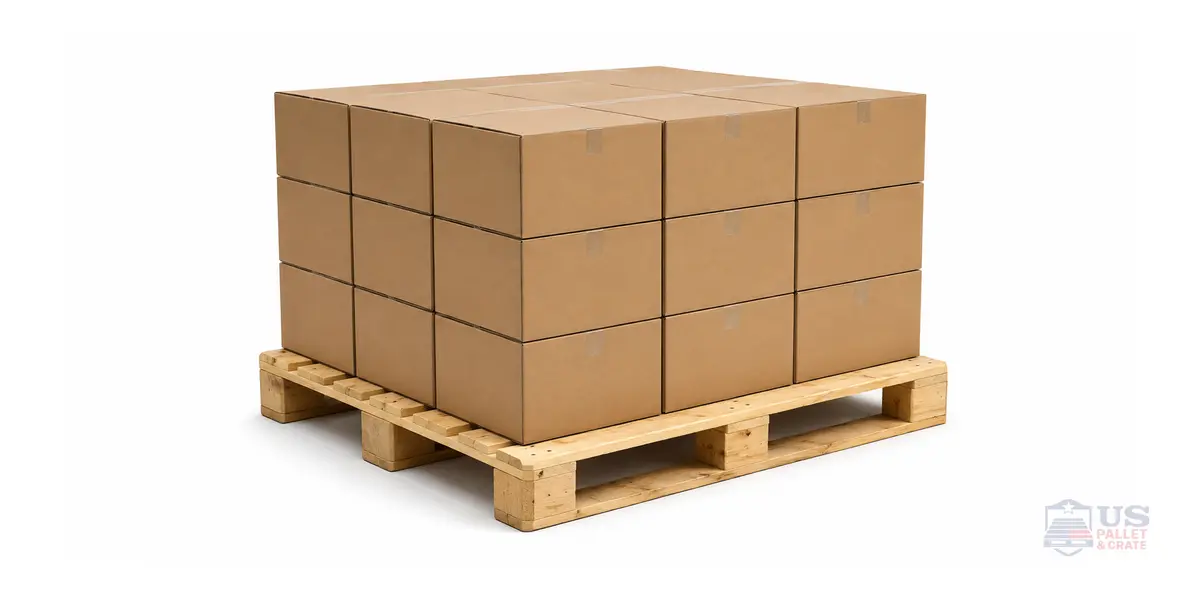
Pick the pallet from three things: the footprint of your load, the equipment that moves it, and the rack it sits in. In North America the default is the 48 x 40 inch GMA pallet, and if your load fits it, use it, because it is the cheapest and most available pallet there is. If the load overhangs or your rack cannot take it, you need a custom size. Capacity is three separate numbers rather than one, and the racking number is always the smallest of the three.
| Size | Where you see it |
|---|---|
| 48 x 40 in | The GMA pallet. The North American default and by far the most available. Grocery, retail, general distribution. |
| 42 x 42 in | Drums and chemical handling. |
| 48 x 48 in | Drums, and loads that need a square footprint. |
| 36 x 36 in | Beverage and smaller unit loads. |
| 48 x 45 in | Automotive. |
| 1200 x 800 mm (47.24 x 31.50 in) | The Euro pallet. European trade and returnable pool systems. |
| 1100 x 1100 mm (43.30 x 43.30 in) | Common across Asia, particularly ocean freight out of Japan and Korea. |
If you can make 48 x 40 work, make it work. Availability is better, replacement is faster, and every warehouse in the country already knows how to handle it. Go custom when the load genuinely does not fit, not because a custom size feels tidier.
A stringer pallet uses three lengthwise boards, the stringers, between the top and bottom decks. A block pallet uses nine blocks, usually three rows of three.
The deciding question is usually not strength, it is how the pallet gets picked up. If your operation runs pallet jacks, or drivers approach from whichever side is convenient, block or notched stringer is worth the money. A pallet jack forcing its way into an unnotched stringer pallet destroys the pallet and sometimes the load.
These get quoted interchangeably and they are not interchangeable. Three different numbers, and they can differ by a lot.
| Rating | What it means | Relative size |
|---|---|---|
| Static | What the pallet holds sitting still on a flat solid floor, fully supported underneath | Largest |
| Dynamic | What it holds while being moved by a forklift or pallet jack | Middle |
| Racking, sometimes called edge rack | What it holds supported only at two edges, spanning open beams with nothing underneath the middle | Smallest, usually by a wide margin |
If your pallets go into racking, the racking capacity is your capacity. A pallet quoted at a big static number can deflect or fail across open beams at a fraction of that load. When somebody quotes you one capacity figure with no qualifier, assume it is the static number and ask for the racking figure.
Also worth checking: whether the rack has wire decking or support bars. A supported deck changes the problem completely, because the pallet is no longer spanning open air.
Rated capacities for our standard builds run 1,500 to 2,500 lbs, and where you land in that range depends on the lumber, the deck board count, the fastener pattern and the span. Tell us your span and whether the pallet goes into racking and we will give you the figure that applies to your load instead of a headline number.
Overhang is when the load extends past the edge of the pallet. It looks harmless. It is not.
The fix is either a smaller unit load or a bigger pallet. If your load is 50 inches across, stop buying 48 inch pallets and hoping. That is what Custom Pallet Supply exists for, and for anything genuinely outsized, Oversized Pallet Supply.
Underhang has a cost too. A load noticeably smaller than the deck is paying to ship air, and in racking it wastes a position.
Do the arithmetic rather than trusting a number somebody remembers. A 53 foot dry van gives you roughly 630 inches of usable floor length and roughly 98 inches of width. For a 48 x 40 pallet:
Turning the pallets gains four positions per trailer. Whether you can actually do it depends on your real trailer width, your load and your loading equipment, so measure your own trailers before you rebuild a shipping plan around it. Double stacking, where the load allows it, doubles the count again.
The wider point: four extra pallets per trailer on a lane you run every week is real money, and it comes from pallet footprint, not from negotiating with the carrier.
Six answers and we can tell you whether a standard 48 x 40 does the job or whether you are better off with a custom build. When the standard works, we will say so.
Contact our office for further assistance. We are here to provide clear answers and help you understand how we can meet your needs effectively.
Call Us (832) 702-848048 x 40 inches, known as the GMA pallet. It is the most widely used and most available footprint in North America, which makes it the cheapest to buy and the fastest to replace.
Static is what the pallet holds sitting still on a solid floor. Dynamic is what it holds while being moved. Racking is what it holds spanning open beams with no support underneath the middle. Racking is always the smallest of the three and it is the one that matters if you use racking.
A stringer pallet uses three lengthwise boards between the decks and allows two way forklift entry, or partial four way if the stringers are notched. A block pallet uses nine blocks and allows true four way entry from any side. Block pallets cost more and generally take more abuse.
Yes. Product hanging past the pallet edge has no support underneath, loses compression strength because boxes carry load through their corners and edges, and is the first thing forklifts and door frames hit. If your load overhangs, get a bigger pallet.
1200 x 800 mm, which is 47.24 x 31.50 inches. It is used across European trade and in returnable pool systems.
Roughly 26 standard 48 x 40 pallets loaded straight, or about 30 if you turn them so the 48 inch side runs across the trailer. Both figures are floor positions before any double stacking, and your real trailer dimensions should be checked before planning around them.
When the load genuinely does not fit a standard footprint, when it overhangs, or when your racking or equipment will not take a standard size. If a 48 x 40 works, use it, because availability and price are both better.
Not necessarily, but notching the stringers on a stringer pallet to allow pallet jack entry does remove material at the notch, which is where a notched stringer pallet is weakest. A block pallet gets true four way entry without that trade off.
